
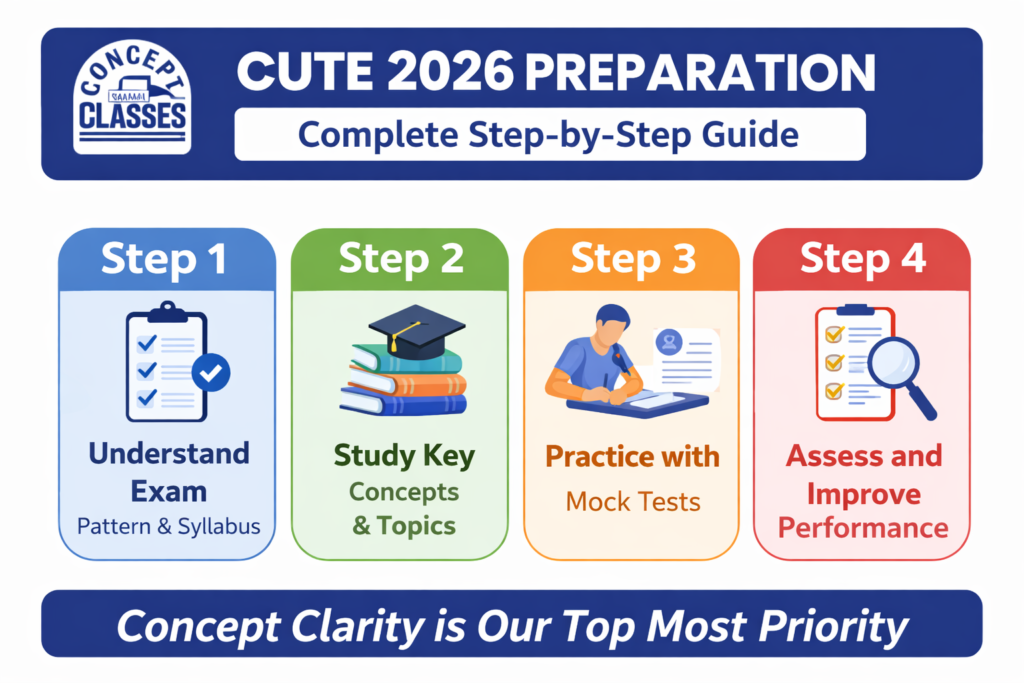
Only studying for long hours will not guarantee success. You need proper guidance, a clear understanding of the exam pattern, and a simple study plan that you can actually follow. This CUET 2026 Preparation: Complete Step-by-Step Guide will help you understand what to study, how to plan your time, and how to prepare in a smart way. With the right strategy and consistent effort, cracking CUET 2026 becomes much more manageable.
What is CUET 2026?
CUET, conducted by the National Testing Agency (NTA), is a national-level entrance exam that determines admissions to undergraduate programs across 250+ universities in India. CUET 2026 is expected to be held around May–June 2026, with registrations likely opening in early 2026.
The exam is divided into three sections:
- Section IA & IB – Languages (you choose based on your preference)
- Section II – Domain-specific subjects (related to your chosen field of study)
- Section III – General Test (reasoning, current affairs, quantitative aptitude)
Understanding this structure is the very first step toward intelligent preparation.
Step 1: Know the CUET 2026 Syllabus Thoroughly
One of the biggest mistakes students make is studying random topics without checking the official syllabus. CUET 2026 is largely based on the NCERT Class 12 curriculum. This is great news because it means you do not need to buy expensive coaching materials right away.
Start by downloading the official syllabus from the NTA website. Go through it subject by subject, mark the chapters you are strong in, and highlight the ones that need more attention. This simple exercise gives you a clear picture of where you stand and how much ground you need to cover.
For domain subjects like Physics, Chemistry, Mathematics, Biology, Economics, History, Political Science, and Business Studies, stick to NCERT books as your primary resource. These books are carefully aligned with what the exam tests.
Step 2: Create a Realistic Study Schedule
A study plan is only as good as your ability to follow it consistently. Many students create elaborate timetables but abandon them within a week. Here is how to build one that lasts:
Phase 1 (Months 1–3)
Focus on building concepts. Read NCERT thoroughly, make short notes, and understand fundamentals without rushing through topics.
Phase 2 (Months 4–5)
Start practicing previous year question papers and mock tests. Identify weak areas and revisit them. This phase is about applying what you have learned.
Phase 3 (Last 4–6 Weeks)
Revise, revise, and revise. Practice full-length mock tests under timed conditions. Work on improving your speed and accuracy.
Give at least 6–8 hours of focused study daily if you are in your gap year, or 3–5 hours if you are a Class 12 student managing board exams alongside CUET prep.
Step 3: Master the Language Section
The language section (Section IA/IB) tests reading comprehension, vocabulary, grammar, and literary aptitude. Many students underestimate this section, which is a costly mistake.
To prepare well:
- Read English newspapers like The Hindu or Indian Express daily to improve comprehension speed
- Practice reading passages and answering MCQs within time limits
- Work on grammar fundamentals — tenses, articles, prepositions, and sentence correction
- Build your vocabulary by learning 10 new words every day using apps or flashcards
If you are opting for a regional language, focus on grammar rules specific to that language and practice comprehension passages from quality preparation books.
Step 4: Crack the General Test Section
The General Test is where many students lose precious marks. It covers current affairs, general knowledge, numerical ability, quantitative reasoning, and logical reasoning. This section rewards students who are consistent in their daily learning habits.
Here is how to prepare:
- Follow a reliable current affairs source daily (newspapers, monthly magazines, or YouTube channels dedicated to GK)
- Practice quantitative aptitude from books like RS Aggarwal or refer to online practice sets
- Solve logical reasoning puzzles regularly — these can be practiced on free platforms online
- Take topic-wise quizzes regularly to reinforce learning
Do not try to cram the entire General Test syllabus in the last month. Instead, build your knowledge week by week, and review it periodically.
Step 5: Focus on Domain-Specific Subjects
Your domain subject score plays the biggest role in university admissions, so this section deserves maximum attention.
For Science Stream Students
Physics, Chemistry, and Biology/Math — NCERT is king. Read every line carefully, including examples and exercises.
Practice numerical problems daily for Physics and Chemistry.
For Biology, focus on diagrams and definitions — they are frequently tested.
For Commerce Stream Students
Economics and Business Studies — understand concepts deeply, not just definitions.
Practice numerical problems in Microeconomics, Macroeconomics, and Accountancy.
For Arts/Humanities Stream Students
History, Political Science, Geography, and Sociology — focus on important events, terms, dates, and analytical understanding.
Practice writing short answers to open-ended questions to build clarity of thought, even though CUET is MCQ-based.
Step 6: Practice Mock Tests Regularly
There is no shortcut to this. Mock tests are the single most powerful tool in your CUET preparation arsenal. They help you:
- Get familiar with the exam interface
- Build time management skills
- Identify recurring weak areas
- Reduce exam-day anxiety
Aim to take at least 2 full-length mock tests per week during Phase 2, and increase this to 3–4 per week in the final month.
After every mock test, spend equal time analyzing your mistakes. Understanding why you got something wrong is more valuable than simply answering more questions.
NTA releases official sample papers and previous year questions these should be your go-to practice material since they best reflect the actual exam pattern.
Step 7: Manage Your Time During the Exam
CUET is not just about knowledge it is also a race against the clock. Each section has a set time limit, and poor time management can cost you even if you know the answers.
Practice these strategies:
- Attempt easy questions first
- Do not get stuck on difficult ones
- Mark doubtful questions for review
- Keep track of time every 10–15 minutes
- Avoid spending more than 60–90 seconds on any single question
Regular mock test practice under timed conditions will naturally improve your pacing over time.
Best Books for CUET 2026 Preparation
While NCERT is your foundation, here are some additional resources that can boost your preparation:
- General Test: Arihant’s CUET General Test Guide, Oswaal CUET Practice Papers
- English: Wren & Martin for grammar, any CUET-specific English workbook
- Domain Subjects: NCERT (mandatory), MTG or Arihant subject guides for extra practice
- Online Platforms: NTA’s official website, Embibe, Unacademy, and YouTube channels
Common Mistakes to Avoid
- Ignoring NCERT and jumping straight to coaching materials
- Studying without a plan or timetable
- Skipping mock tests or not analyzing them afterward
- Leaving the General Test or Language section for the last moment
- Comparing your progress with peers instead of focusing on personal improvement
Stay Consistent and Believe in the Process
CUET 2026 preparation is a marathon, not a sprint. Students who succeed are not necessarily the most talented they are the most consistent. Start early, follow your plan, take mock tests seriously, and take care of your mental and physical health throughout the journey.
Sleep well, eat right, and take short breaks to recharge. Burnout is real, and no exam is worth your well-being.
With the right strategy, regular practice, and proper guidance at Concepts Classes Vikas Puri, cracking CUET 2026 and getting admission into your dream university is completely possible.
All the best! Your hard work today will define your tomorrow.